
Description
Click here: Contents and Preface

$24.77
Epigraph
In South Africa, December 25 falls in the middle of summer and is traditionally one of the best days to relax outdoors, with trees all green, ducks and geese everywhere in ponds and lakes, enjoying the world’s best climate, braaivleis, spending time with family, and looking ahead to the good days to come.
By December 1995, I had spent nearly a year alone in the United States, finding new ways to earn a living, establish a home, and build a future for my two-year-old son, Akiva, and my first, late, wife, Kim. That year, I returned to what was then called the “Rainbow Nation”– to reunite with family and friends.
My country elected its first Black president, Nelson Mandela, on May 10, 1994, alongside the Afrikaner President W. F. de Klerk. Returning to South Africa brought back painful memories of the day seven years earlier, when I, as a journalist, had been forced into exile from the country where I had sought to live and to strive for freedom.
On Christmas Day, many South Africans go to church, visit parks, head to the beaches on both the Atlantic and Indian Oceans to swim or catch fish, ski on the great dams and rivers, take long hikes in the Drakensberg mountains, or explore the incredible nature reserves, like Paul Kruger’s. Kim and I left Akiva at home with my mother, Elaine, and explored the old Japanese Gardens Park in Johannesburg’s northern Jewish suburbs.
Many people sat by the ponds, lay on the grass, looked up at the clear blue sky, and ate “boerewors” from the “braais.” We talked about our beautiful son and the possibility of returning to Israel or moving to the USA for good. But after Iraq’s President Saddam Hussein was defeated in his invasion of Kuwait, he continued to attempt to destroy Israel with his missiles. My interviews with reporters covering the Gulf War made me realise that fighting Iraq would drag on for many more years. Returning to Israel was therefore impossible. The Gulf War ended any possibility of working in Israel, and many businesses, hotels, and opportunities collapsed. So, we looked up to Heaven, and talked about staying in South Africa, a place I still missed.
We realised it was getting dark. We looked around and saw that everyone else had already left. We returned to my mother’s manual white Opel Kadett and tried to start it, but the engine refused to turn over. It had never failed before. A chill ran down my neck, and I quickly checked the rear-view mirror. I noticed two well-dressed Black men walking towards us from about 100 metres away. They looked like police. Bang. The first shot. The bullet penetrated the back window, ripped through my seat, and entered my back. It stopped just to the right of my spine, very close, behind my heart. The shot left me completely paralysed. I thought my spinal column had been severed.
I kept trying to start the car again, to escape what was coming, but I could only move and lift my right hand. The man with the gun came to my right window, looked straight at me, pointed the gun at my head about ten centimetres away, and fired the second bullet. My right hand instantly rose on its own, in front of my face. The bullet ripped into my hand, destroying all my hand bones and severing my veins. But the bullet, like the first one, froze. It would not exit my hand. Blood poured out and sprayed everywhere in the car.
The other man opened my wife’s door, pulled her out, and dragged her about 30 metres from the car. He yelled at her not to scream, then punched her in the face several times, severely breaking her nose and knocking her unconscious.
The gunman dragged me out of the car and threw me onto the grass. He took our bags from the car, searched my wallet, and ripped off my Seiko diving watch. He then pulled out my two passports: one South African and the other Israeli. He also examined my South African identity book, looked at me again, and said: “You are a South African, and you are also a South African Jew.” I could not reply. He then asked, “Where is your 357 Magnum gun?” He had seen my gun licence in my identity book. I still could not speak. Despite the pain and panic, I kept thinking about my wife. The gunman then pointed his gun at my head. He was about to end my life. I lost consciousness.
About 30 minutes later, I regained consciousness and heard my wife crying. The two men had vanished. My body began to move again, and I crawled to her. The shooter had left my passports and belongings on the grass, taking only my Seiko watch and our money. We crawled towards the main road outside the park. Within minutes, a grey Mercedes-Benz pulled over. A Jewish man and his wife had noticed us. I hardly remember how he got us into the car. They rushed us to Johannesburg Hospital.
I had lost almost 50 per cent of my blood, a Class IV haemorrhage, and was going into shock. The emergency chief doctor said, “Start an immediate infusion now, or we will lose him.” Once my blood level returned to a safe level, they put me under to operate on my destroyed hand.
Click here: Contents and Preface
A few days later, the senior Afrikaner surgeon who saved me rebuilt my hand with screws. He told me both bullets were the same type—9mm—and were used by the police. He also said the bullet lodged behind my heart should be left in place because it was in a safe position, embedded in my muscle. “I don’t know how you survived. Many people here don’t survive what you just went through,” he said.
The surgeon advised me to stay in the hospital for at least 10 days. But I feared that the man who tried to kill me might return and finish me off. After all, I was thrown out of the country six years earlier after I widely criticised the new “after apartheid” plan. I flew out a few days later, still bleeding on my back and dragging my luggage with one nailed and screw-up hand. Kim stayed behind. She needed surgery to rebuild her smashed nose. But I was not coming back.
If this attack had happened to me today, I would not have survived. My country of birth is dying. In 2027, the country has one last chance to restore “the rainbow” and to reform the way it is being ripped apart and exploited. We must agree on a new political system that addresses the turmoil gripping the country and rejects the Marxist, jihadist, racist, and evil forces that are holding it back and making it the most violent place in the world. We need a system that governs with love and honour and rejects ongoing racism, anti-Semitism, murder, crime, and rape in all forms. We must also remove the apartheid laws that remain and prevent the ANC and its cadres from introducing new apartheid laws. This year, we need to begin a new rule of law and choose a different path from the evil one we are on now.
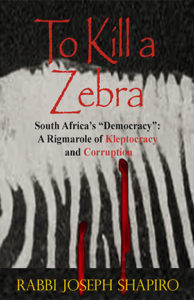
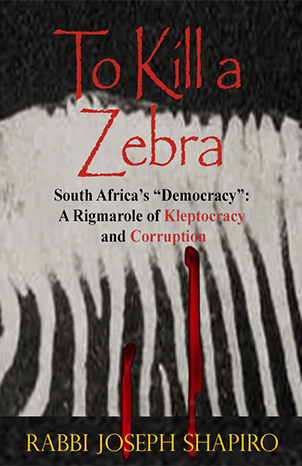
We are a population of “zebras”: kind and gentle. More than 80 per cent of us—about 55 million people—are Judeo-Christians, and about 50,000 South Africans are Jewish, dreaming of returning to the promised land, Israel, the country we love. Yet God also calls us to do Gideon’s work for Judeo-Christian people, many of whom live in South Africa. As Roelof Frederik “Pik” Botha, the last Minister of Mineral and Energy Affairs, a White Afrikaner under Mandela, said to me in an interview while he was involved in foreign affairs: “Our black people and our white people are separate . . . but equal. But we are all like zebras: if the black parts of the zebra get shot, the white dies too; and if the white part gets shot, the black parts die too.” South Africa: If we don’t stop the killing now, all the “zebras” will die.
(Hardcover: February 28, 2027. Audio/Kindle: To be released. Softcover: To be released.)
Available on backorder
| Authors | Credo Mutwa, Joseph Shapiro |
|---|---|
| Publisher | United Publishers International |
| Number of pages | 350 |
| Format | Paper Book, Hardcover |
This site uses functional cookies and external scripts to improve your experience.
Privacy settings
Privacy Settings
This site uses functional cookies and external scripts to improve your experience. Which cookies and scripts are used and how they impact your visit is specified on the left. You may change your settings at any time. Your choices will not impact your visit.
NOTE: These settings will only apply to the browser and device you are currently using.
Advertisement


Reviews
There are no reviews yet.